G REGISTERED AIRCRAFT - IN SOUTH AFRICA?
By Ron Wheeldon
15.11.2027
Google Banner Ad
It seems incredible now, but did you know that South African light aircraft were once adorned with the same G registration as British aircraft? The very first light aircraft registered in South Africa was a De Havilland DH60 “Moth” registered G-UAAA. As time has gone by, and following the nationality Acts passed all through the empire back in 1948, and the formation of the Republic in 1961, it has faded from the general memory just how close the relationship used to be. I was fascinated to find that the first aircraft owned by my Club, the JLPC, was a De Haviland DH60X “Cirrus” Moth registered G-UAAD! The first registration actually belonged to the Port Elizabeth Light Aircraft Club and was G-UAAA.
The first flying club formed in South Africa was formed on 7 December, 1926, but during the first year of its existence it had no aircraft and no money with which to buy one. The beginnings were a meeting at a small hotel at Uncle Charlies, outside Johannesburg, when Col. Rod Douglas and Stan Halse (and probably Major Miller and J H Veasey) convened a meeting of more than 130 air minded enthusiasts and formed the Johannesburg Light Plane Club, aka the JLPC. Much of the drive behind the formation of the club had come from the said “Major” Allister Miller, a WW1 veteran, who had run the first commercial air service in South Africa from Baragwanath airfield, which is where the JLPC would operate from. It was the first of several light plane clubs to be formed in South Africa - there was Durban Light Plane Club and several others. Miller was a member of parliament at this time and was doing all he could to promote aviation in South Africa. He brought one of the first DH60X “Cirrus” Moths out to South Africa in 1926 (some sources say 1927) and demonstrated it around the country. Below is a picture of the Moth flying from the Esplanade in Durban.
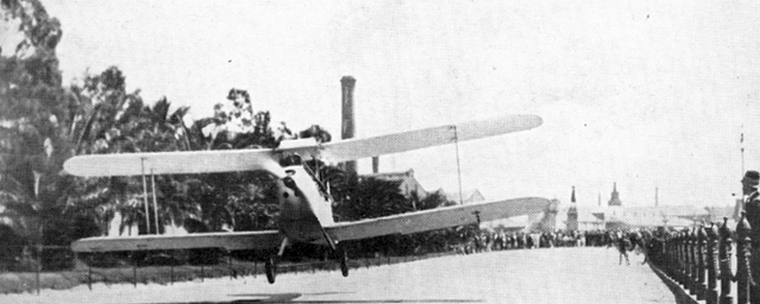
First light aircraft in South Africa with CofA no 1083 issued 28.1.27. It was registered G-UAAA on 14.4.27 to Major Allister M Miller, Cape Town; named "The Point". Shipped to be erected in Cape Town the aircraft was assembled on quayside and flown on a 2,400 mile round trip tour of South Africa by Miller 15.4.27-23.4.27. It was transferred to the Port Elizabeth Light Aeroplane Club Ltd and later re-registered as ZS-AAA 1.29. (source - DeHavilland Aircraft Association, South Africa.)
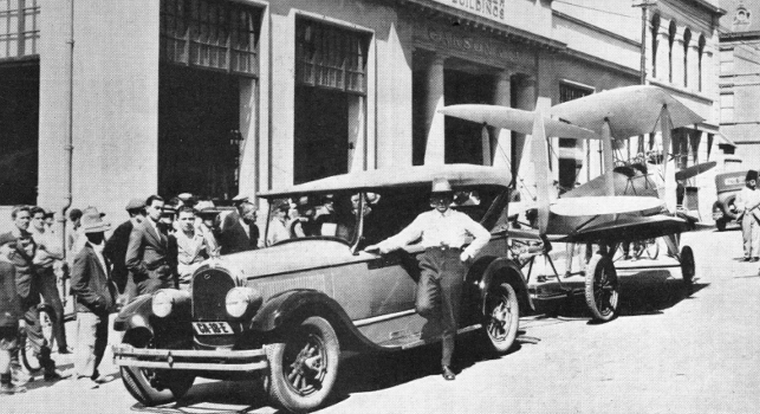
It had folding wings to facilitate easy storage and it could be towed behind a car, as Major Miller demonstrated often. The picture below shows the aircraft with wings folded but unfortunately the registration is not visible in the photo.
The JLPC managed to lease the airfield at Baragwanath in 1927 and commenced operations in September 1927 with an Avro Avian leased to the club by Glen Bateman and then an initial Cirrus Moth, registered G-UAAD (or, possibly, G-UAAO). The De Havilland agent in South Africa, John Veasey, established the DH headquarters at Baragwanath and it seems that there was quite a brisk turnover of the little Cirrus Moths between Mr Veasey and the various clubs. It was noted that Mr Veasey and his daughter flew a Cirrus Moth from Baragwanath to Durban and back, the same day, the first intercity return flight in South Africa.
Back in the UK, supply of Cirrus engines was sporadic, so the DH company had brought the designer of the Cirrus, Frank Halford, on board to design and build their own Gipsy engines, which were almost identical to the Cirrus, but had the advantage of development. A curious feature they share is that the internal dimensions are metric, but the external ones are Imperial! The new version of the Moth was known as the Gipsy Moth and after the Club's then only Cirrus Moth was written off in 1929 Sir Charles Wakefield came to the rescue and presented the JLPC with a Gipsy Moth, ZS-ABM, in October 1929. This was a ZS registration because South Africa adopted the ZS registration scheme from January 1929.
In the early days the JLPC was a popular spot for picnics and hundreds of air minded people would motor out to the airfield at Baragwanath to watch the flying while picnicking and socialising under the trees edging the airfield. The first air show in South Africa was well supported by the SAAF with DH9 aircraft and was very well attended. As the Club gained funding from its early impecunious start a magnificent clubhouse was built and run on a level almost equal to the Rand Club with white suited and gloved waiters sporting the then popular fez, silver cutlery and all the other trappings of high society. The flying school burgeoned under the leadership of Stan Halse. By 1930 (when the JLPC company was incorporated) the Club had flown 2000 hours and had trained 13 pilots, including South Africa's first commercial pilot, a Mr G B Williams. The JLPC was the recipient of the first 3 DH82 Tiger Moths imported to South Africa which were painted in the JLPCs maroon and silver livery.
It was a relatively brief period between the starting of the flying at Baragwanath and the outbreak of World War 2 which resulted in the confiscation of the Club's aircraft for the war effort, but a lot was fitted in. The Gipsy Moth met its end in SAAF service, but, by 1945 Baragwanath was a major parking area for Hurricanes, P-40 Kittyhawks and all sorts of other aircraft being unceremoniously scrapped. The Club was able to buy a few Tiger Moths from disposal sales and recommence flying at Baragwanath, but that's another story!
A little known fact is that Colonel Rod Douglas, one of the founders of JLPC, was instrumental in founding the SAAF Association in 1945 and in pursuing the constructions of the SAAF Memorial near the former AFB Swartkop.
|
        |